

The One-Sided Ceiling: How Uber’s New Ballot Measure Disarms Accident Victims
1. Introduction: The Collision of Convenience and Accountability
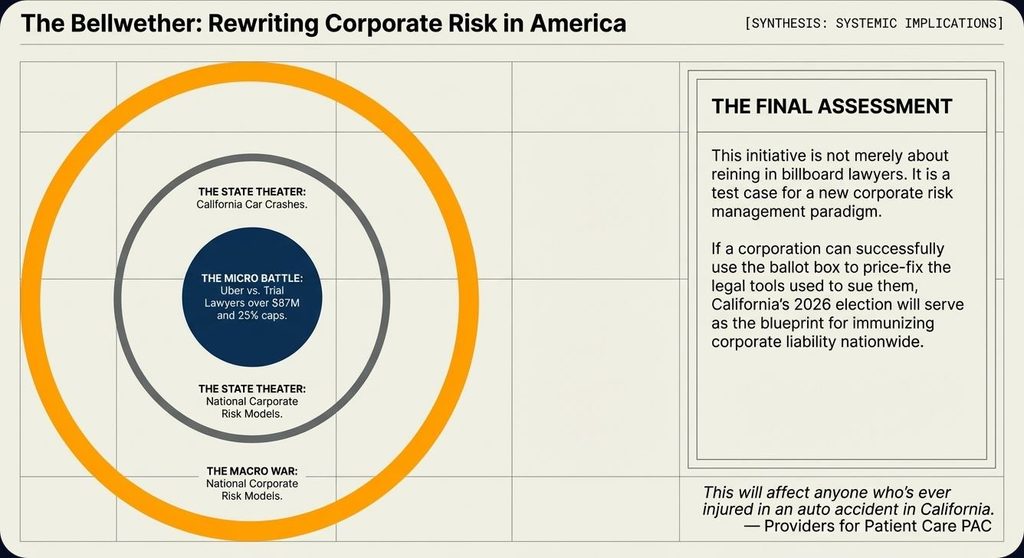
Imagine the sudden, visceral jolt of a t-bone collision at a suburban intersection. In the disorienting seconds that follow, a victim isn’t thinking about ballot initiatives or insurance actuarials; they are thinking about the mounting costs of surgery and the sudden loss of a paycheck. This moment of extreme vulnerability is the epicenter of a high-stakes political war. Uber is currently bankrolling a 2026 ballot initiative titled “A More Affordable California,” framed as a common-sense rescue mission to protect victims from “predatory lawyers” and “inflated bills.”
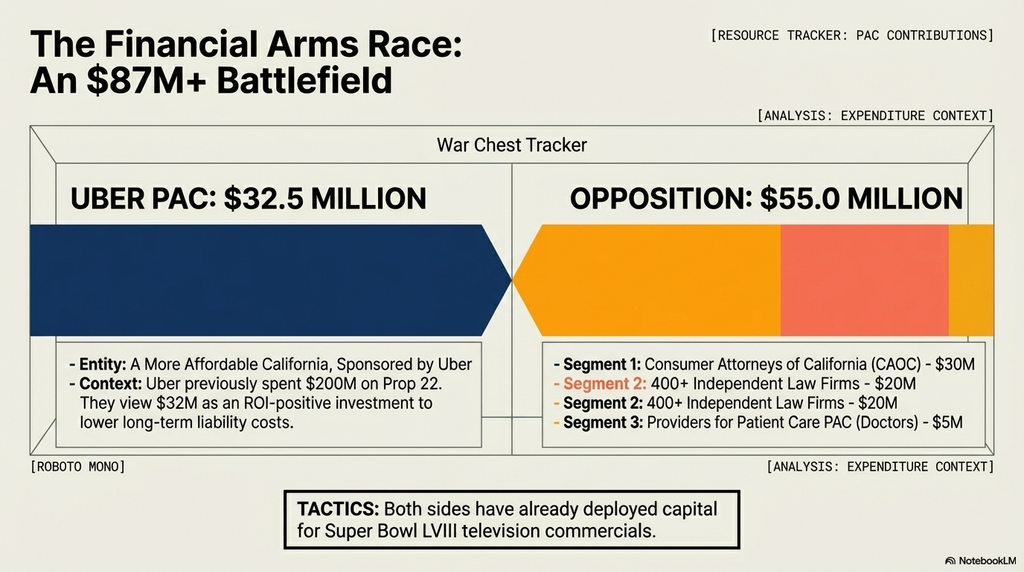
But beneath the populist rhetoric lies a calculated corporate maneuver. Uber’s strategy relies on a classic political sleight of hand: solving a genuine problem—inflated medical billing—with a solution that effectively dismantles the victim’s legal engine. The financial scale of this fight reflects its gravity; state records show Uber has already poured $32.5 million into the measure, while a coalition of trial lawyers and medical providers has committed roughly $55 million to kill it. What is being sold as “affordability” may, in fact, be the systematic removal of the average citizen’s “key to the courthouse.”
2. Takeaway 1: It’s Not Just About Uber (The Universal Scope)
The most dangerous misconception about the “A More Affordable California” initiative is that it only regulates ride-sharing. In reality, this is a total overhaul of the liability system for every vehicle crash in the state. Whether you are struck by an Uber, a delivery van, or a private commuter, your ability to recover damages will be dictated by these new rules.
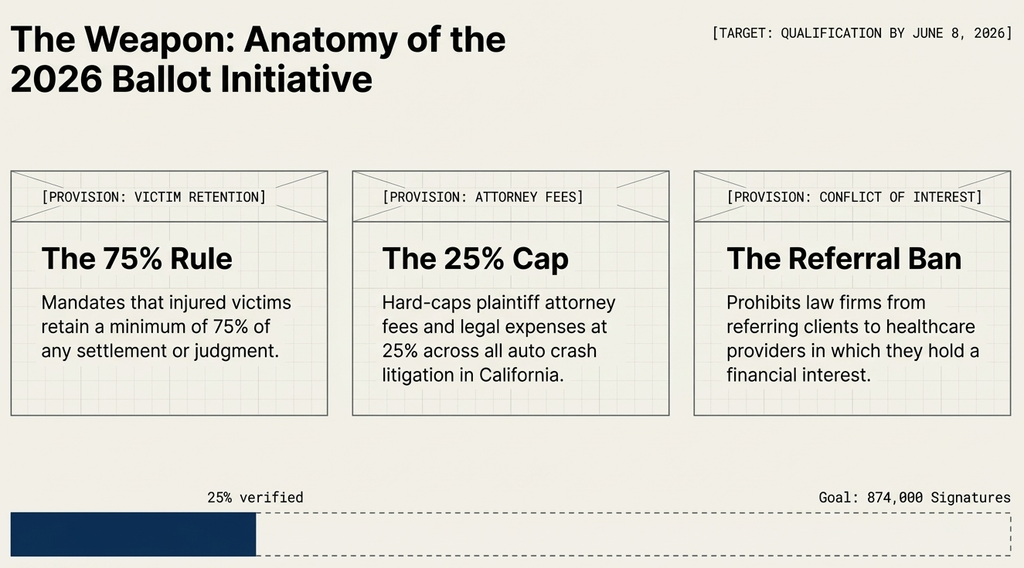
The initiative’s power lies in its simplicity. By pitching a “75% guarantee” for victims, the campaign leverages what legal scholars call a “bumper sticker quality” that masks a radical narrowing of constitutional rights. It is an attempt to rewrite the rules of the road for 40 million people under the guise of corporate “reform.”
“This measure could backfire for Uber, but it’s certainly possible that California voters will approve (the company’s) initiative because it has a ‘bumper sticker quality’ to it,” said Stanford University law professor Nora Freeman Engstrom.
3. Takeaway 2: The Hidden Math of the “75% Rule”
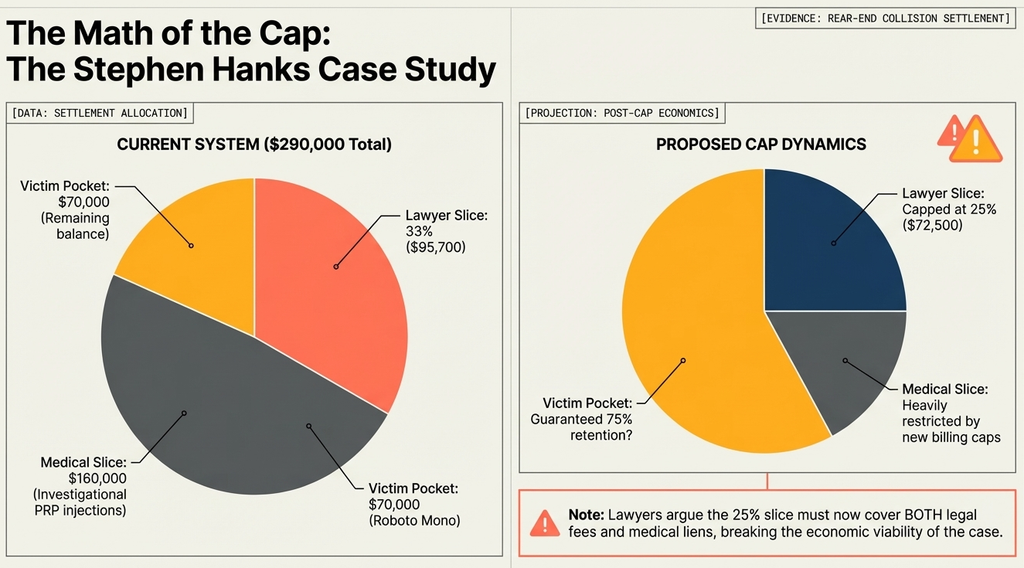
The centerpiece of the measure is the requirement that victims retain at least 75% of any settlement. It sounds protective until you look at the math of the remaining 25%. In the current system, a lawyer’s fee (usually 33% to 40%) is separate from the “costs” of the case—the tens of thousands of dollars required to hire accident reconstruction experts, specialized surgeons for testimony, and private investigators.
Under Uber’s measure, that 25% must cover both the attorney’s fee and every single litigation cost. This creates a literal disarmament in the courtroom. While a victim’s legal team is forced to work within a capped, shrinking budget, a multibillion-dollar corporation like Uber faces no such restriction, allowing them to spend unlimited sums on high-priced defense teams and exhaustive internal investigations to outlast the victim.
“These limits would apply only to the injured person’s side of a case. Large corporations and insurance companies would continue to spend without restriction on defense teams, internal investigations, and prolonged litigation.” — Avrek Law
4. Takeaway 3: The “Fine Print” Trap of Medical Liens
To combat what it calls “medical buildup”—the practice of inflating bills to sweeten settlements—the measure ties all medical recoveries to national databases, specifically 125% of Medicare or 170% of Medi-Cal rates. But the real “fine print” is found in the initiative’s “convoluted language,” as Professor Engstrom describes it. Legal analysts warn that the measure is written such that medical expenses and liens might actually be forced to come out of the attorney’s 25% share, rather than being deductible from the total settlement.
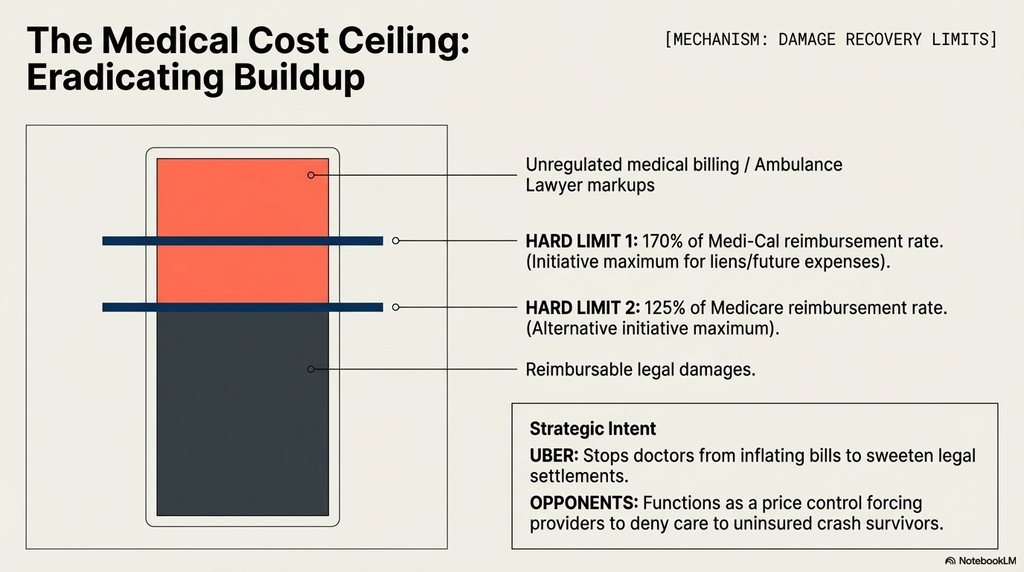
This creates a paradox: if the attorney’s 25% share is exhausted by medical liens and expert witness fees, there is no money left to pay the lawyer. Uber claims this prioritizes the victim, but the structural reality suggests it may simply prioritize the elimination of the victim’s advocate.
“Californians deserve a system that prioritizes victims over billboard lawyers,” said Adam Blinick, Uber’s director of Public Policy and Communications for the U.S. and Canada.
5. Takeaway 4: The Synergy of Lowering the Floor and the Ceiling
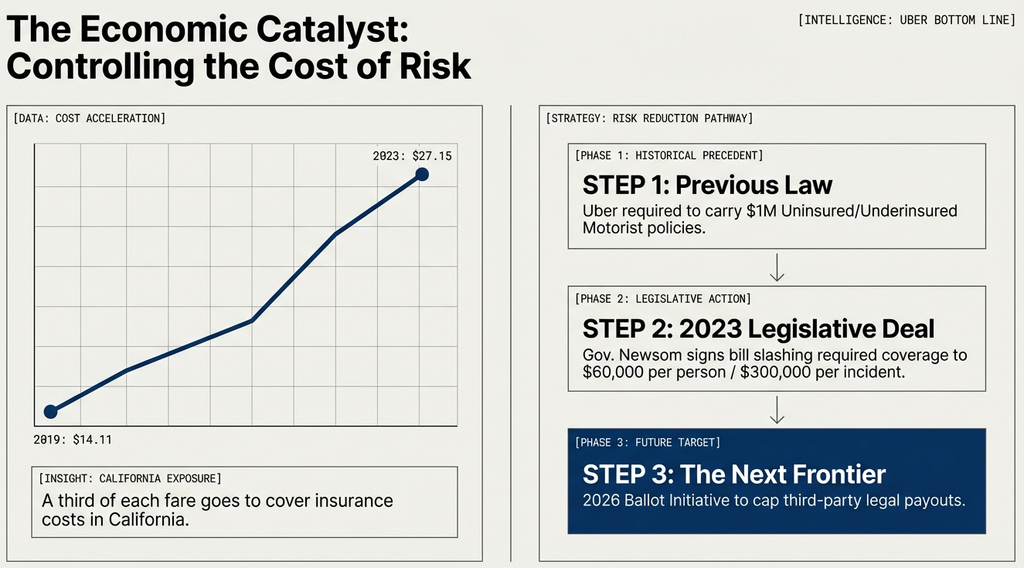
This ballot measure is the second phase of a broader business strategy to insulate Uber from the costs of human error. Between 2019 and 2025, the average Uber fare in California nearly doubled, climbing from roughly $14 to over $27. Uber has been transparent with investors: insurance costs consume roughly one-third of every fare.
The synergy of their political maneuvering is unmistakable. First, in 2025, Uber successfully lobbied for a legislative deal that lowered the “floor”—slashing the required insurance minimums for uninsured/underinsured motorists from $1 million down to a mere $60,000. Now, they are attempting to lower the “ceiling” by capping what they can be sued for. By driving down the cost of liability, Uber aims to shore up its bottom line at the expense of those catastrophically injured.
6. Takeaway 5: The “Muzzle” Effect on Complex Cases
The most chilling consequence of a hard 25% cap on fees and costs is the “muzzle” effect. Complex cases require significant upfront financial risk from attorneys working on contingency. If the budget for experts is capped, lawyers simply cannot afford to prove complicated liability.
Consider the case of Stephen Hanks, who was rear-ended by an Uber driver. He received platelet-rich plasma injections—an “investigational procedure” that Uber’s narrative might label as “unnecessary medical buildup.” To Hanks, however, those injections were the only thing that finally fixed his shoulder. Under the current system, his $290,000 settlement left him with $70,000 after medical bills and fees. Under the new measure, scholars argue a firm might never have taken his case in the first place, leaving him with $0 and a permanent injury.
“In reality, Uber’s ballot initiative won’t protect victims, it will muzzle them,” wrote law professors Nora Freeman Engstrom and Brianne Holland-Stergar.
7. Conclusion: A Question of Public Safety and Access
The battle over “A More Affordable California” is just the opening salvo in a larger legal war. In retaliation, trial lawyers have introduced their own measures, seeking to designate ride-share companies as “common carriers” with higher safety duties and to increase liability for sexual assault reporting.
As voters approach the 2026 ballot, they must decide if the promise of slightly lower fares and premiums is worth a fundamental shift in the civil justice system. Is the goal truly to protect the victim, or is it to ensure that when a catastrophic accident occurs, the corporation responsible is the only one in the room who can afford to speak?